
 +91-11-42423100
 Excellent Service
A Part of 2 Time National Travel Awards winning Company.
Unbeatable Experience
Served over 2000 cities in more than 180 countries of the world.
Round the clock service
24*7 customer service to assist you.
Lowest Price Guarantee
With our network and experience, low price is all but guaranteed.

Tourist Attractions in New Delhi
New Delhi, the Indian capital city, is home to a number of popular tourist landmarks. Over time, Delhi has enjoyed different personalities, each as distinct as its rulers. The city has hosted a number of dynasties – Aryans, Tughlaqs, Lodhis, Mughals, British – each of which has left a distinctive influence on the culture and lifestyle of the city. The city was Indraprastha to the Aryans, Dhili to the Tomaras, Shahjahanabad to the Mughals and Delhi to the ruling British and, now, the world today. The city has the Mughals to thank for much of its cuisine, the British and Tughlaqs for its architecture and the entire Indian subcontinent for its diverse culture. If ever there was a greater melting pot of such different cultures and ethnicity than what is Delhi, we do not know of it. Delhi is India at a glance.
Attractions in Delhi are scattered all over the city and our New Delhi tours will take you to the crème la crème of Delhi’s tourist hotspots. The “Tourist Attractions of Delhi” page is an exhaustive list of all important tourist attractions in Delhi, from Qutub Minar to Raj Ghat and Purana Qila to Delhi Haat. Each attraction has a dedicated link to its individual page, following which you can access detailed information about the same. For now, you can browse through the respective overviews of the best tourist attractions in Delhi.
 1- Rashtrapati Bhawan – Official home of the President of India, the Rashtrapati Bhawan is an enormous 320 acre Presidential Estate with a 340 room building (For perspective, the White House in Washington is 18 acres). The estate’s perimeters also include the massive and incredibly beautiful Mughal Gardens, residences of bodyguards and staff, stables, other offices and utilities. The Mughal Gardens themselves are quite popular and visited by thousands in the spring season.
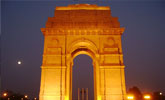 2- India Gate – India Gate is the All India War Memorial that commissioned to commemorate 90,000 soldiers of the Anglo-Indian army who lost their lives during the First World War. After the Indian independence in 1947, the colossal city landmark came to be associated with the country’s freedom fighters and a special edifice, Amar Jawan Jyoti, was established to celebrate the same. The landmark is central to Delhi and links to all major Delhi roads.
 3- Chandni Chowk – Chandni Chowk is the ‘Food Capital’ of the Indian capital. The Walled City, as it is nostalgically called, is an absolute foodie’s delight – housing some of the best sweet shops in North India offering mouth watering servings in Mughalai, Awadh, Marwari and Himachali cuisines. Life is still lived in the slow lane here and it is not uncommon to see the odd snake charmer performing his bagful of tricks on the dangerous King Cobra. A particular treat for photographers, the oldest part of New Delhi is home to several havelis, forts and inns from medieval times.
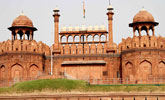 4- Red Fort – One of the greatest architectural accomplishments of the Mughal Emperor Shah Jahan is the Red Fort, a mammoth red sandstone building that hosts the country’s Independence Day every year on August 15. The fort was designated as a World Heritage Site in 2007 and has several sections such as the Diwan-e-Aam and Diwan-e-Khas. A major highlight of all New Delhi tours is the fascinating Light and Sound show held at Red Fort.
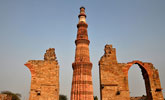 5- Qutab Minar – The tallest minaret in India, a UNESCO World Heritage Site, the crowning glory of the Tughlaqs – these are only a few of the superlatives used to describe the Qutub Minar. The 72 meter high tower, made of red sandstone and marble, is an architect’s delight. The Minar is adjacent to the 7 meter Iron Pillar, a metallurgical enigma that has not corroded despite dating back to the first millennium. The entire Qutub Complex is a must visit attraction on a Delhi tour.
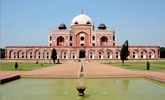 6- Humayun’s Tomb – Did you know it was Humayun’s Tomb that was the original inspiration behind the Taj Mahal in Agra? The Tomb was commissioned by Hamida Begum, Humayun’s wife, to commemorate the life and times of her illustrious husband. Humayun’s Tomb is known for its identical architecture and lush green gardens mostly occupied by naturalists and couples sharing some quality time together.
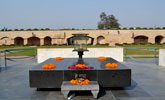 7- Rajghat – It is only obvious that the Father of the Nation’s memorial is one of the most visited landmarks in Delhi. Rajghat is where Mahatma Gandhi was cremated a day after his assassination in Janurary 30, 1948. Rajghat is flanked by lush green lawns and is adjacent to other notable memorials like Shantivana (Jawahar Lal Nehru), Vijayghat (Lal Bahadur Shastri) and Shakti Sthal (Indira Gandhi).
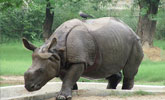 8- National Zoological Park - The Delhi Zoo is a massive eco-sanctuary that is home to more than 1350 animals representing 130+ species of birds and animals. The zoo has a 16th century citadel, sprawling greens and a mini lake, altogether making for a perfect picnic spot. The zoo can be explored on foot or battery operated carts.
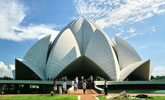 9- Bahai Temple - Green lawns, a small lake, wind chimes chanting a surreal tune – the Lotus Temple in South Delhi makes one forget they are in one of the busiest neighborhoods of India. The lotus shaped Bahai Temple respects all religions and hosts prayers for all faiths.
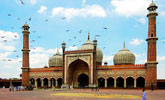 10- Jama Masjid - This monument showcases the true specimen of Indo-Islamic style of architecture. Being built during the rule of Mughal Emperor Shah Jahan, this is the largest mosque in India. Large courtyard, central tank and onion domes are the elements of this mosque All these are built using red sandstone and white marble.
 11- Parliament House – An elegant building with a large hall and wide pillared walkways is worth visiting. The parliament house is located in Central Delhi. This place serves as the corridors of power where you can get the glimpses of lawmakers and statesmen of India working towards a bright future of the nation.
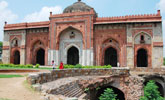 12- Purana Qila – In spite of being called ‘unlucky’ for those who operate from here, this monument has defended the test of time. Amongst the elements of this monument, Gandak Baoli (a well) is dug according to the precision of modern day science. Sher Mandal is another attraction, a two storied building that was once a pleasure resort of Sher Shah. To believe the unbelievable fact that steam bath was an integral culture of the Mughals, you need to pay a visit here.
 13- Delhi Haat – Delhi Haat is probably the best attraction of the city to explore the varieties of the cultural traditions of India. This place is an attempt to display art & crafts, traditions, cultures, etc., of India on one common platform. Locally, this place is called ‘Dilli Haat’ and is known for scrumptious & affordable food, handlooms, handicraft works, Indian textiles, knick knacks, etc. Get a complete sneak-peek of India and enjoy the true colors of this glorious land.
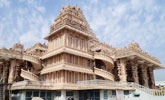 14- Chhatarpur Mandir – Chhatarpur Mandir is the 2nd largest temple complex after Akshardham. The temple being settled over an area of 60 acres, nestles about 20 temples of varied sizes and structures. Herein you can find the main temple that is dedicated to Goddess Katyayani and various adjacent temples of Lord Ganesh, Lord Hanuman, Lord Rama and others. During the Navratri seasons, this place buzzes with devotees from all across India.
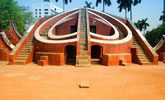 15- Jantar Mantar – A 300 year old observatory consisting of 13 architectural astronomy instruments that were commissioned by the Mughals. The observatory was meant to make astronomical predictions pertaining to the movements of the sun, moon and the planets. The site is bang in the middle of New Delhi and a must visit feature on all New Delhi itineraries.
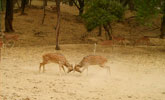 16- Deer Park and Hauz Khas Lake – One of the best picnic spots in the city, the Deer Park in South Delhi is a vast complex consisting of the Hauz Khas lake, Duck Park and the Hauz Khas Fort. Together with the District Park and the Rose Garden, Deer Park is known as “the lungs of Delhi”.
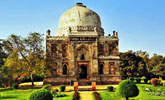 17- Lodhi Garden – The 90 acre Lodi Garden encompass several important heritage monuments such as Mohammed Shah's Tomb, Sheesh Gumbad, Sikander Lodi's Tomb and Bara Gumbad. The Lodi Gardens are a favorite walking spot of Delhiites and are frequented by archaeologists, photographers and nature lovers in general.
New-delhi-hotels.com is your travel guide to know see more of New Delhi tourist attractions For an early sight of the parade on Republic Day get yourself a place here as the soldiers march past the India Gate reaching the Red Fort: Other popular Delhi tourist attractions in New Delhi:
- Air Force Museum
- Central Baptist Church
- Chhatarpur Mandir
- Chiragh-i-Dehli Dargah
- Dara Shikoh Library
- Digambar Jain Temple
- Fatehpuri Masjid
- Ghaziuddin Khan Madarsa
- Gurdwara Bangla Sahib






Kindly give us your requirement and our travel expert will help you to plan your tour.
Plan my Trip!